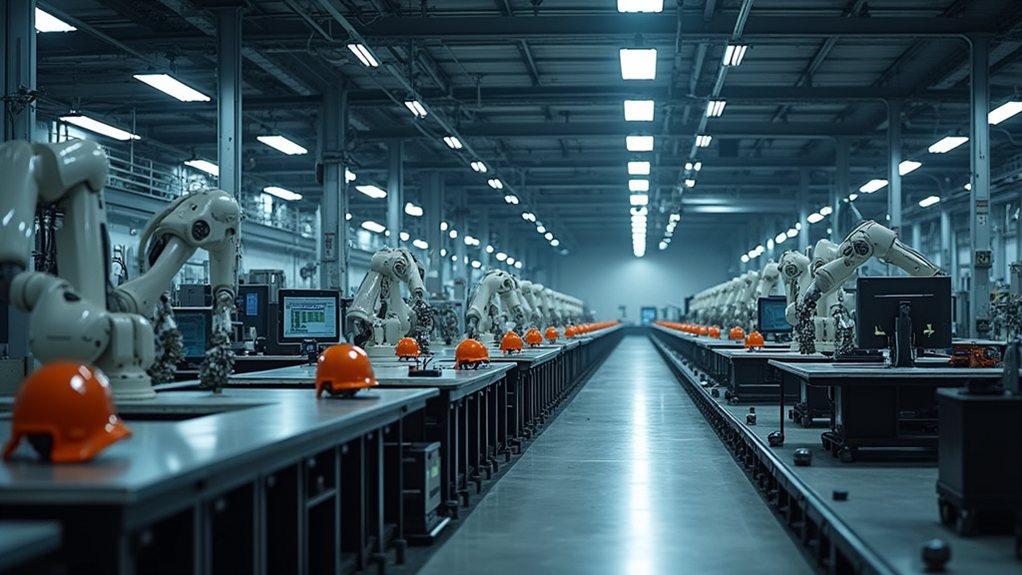

AI offers practical applications for both business and personal life. Companies can boost efficiency by automating repetitive tasks (65% already do), enhance customer service, and potentially increase profits by 45%. At home, AI powers everything from smart speakers to content recommendations. With the global AI market heading toward $1.85 trillion by 2030, it’s not just tech buzz—it’s becoming essential infrastructure. There’s much more to explore beyond these surface-level applications.
While tech enthusiasts have been heralding the “AI revolution” for decades, it’s only now becoming clear that artificial intelligence isn’t just arriving—it’s already unpacked its bags and made itself comfortable in our corporate boardrooms and living rooms alike.
The statistics tell a compelling story: a whopping 77% of companies are currently using or exploring AI in their operations, with 83% making it a strategic priority.
AI isn’t just knocking on the door—it’s seated at the corporate strategy table.
It turns out AI isn’t just for tech giants anymore. From automated emails to customer service chatbots, businesses are finding practical applications that deliver real value. Companies report a 45% increase in profits during early 2023 thanks to AI adoption—not exactly pocket change, folks. The technology particularly shines at eliminating those soul-crushing repetitive tasks that nobody wants to do anyway, with 65% of businesses citing this as their primary use case. In fact, customer service has become the most common application of AI in business, with 56% of companies implementing AI solutions in this area.
The playing field isn’t entirely level, though. Large enterprises are twice as likely to implement AI compared to their smaller counterparts, who face steeper adoption barriers. Data privacy concerns, implementation costs, and the ever-present challenge of getting employees to embrace new technology remain significant hurdles.
Looking beyond the corporate world, AI has seamlessly woven itself into our personal lives. Those smart speakers that occasionally order items you never asked for? AI. The eerily accurate content recommendations that somehow know you’d enjoy that obscure documentary about competitive cheese rolling? Also AI. Generative AI tools are now enabling skilled professionals to boost their performance substantially while handling more complex work.
The future looks particularly bright (or concerning, depending on your perspective) with projections putting the global AI market at $1.85 trillion by 2030. With AI technologies expected to generate 15.7 trillion dollars in revenue by 2030, the economic impact cannot be overstated. Industry-specific applications continue to evolve, with healthcare, manufacturing, and retail seeing particularly innovative implementations.
As AI continues its march into every aspect of our professional and personal existence, one thing becomes increasingly clear: this technology isn’t just another passing tech fad—it’s fundamentally changing how we work, communicate, and live. The robots haven’t taken over yet, but they’re certainly making themselves useful.