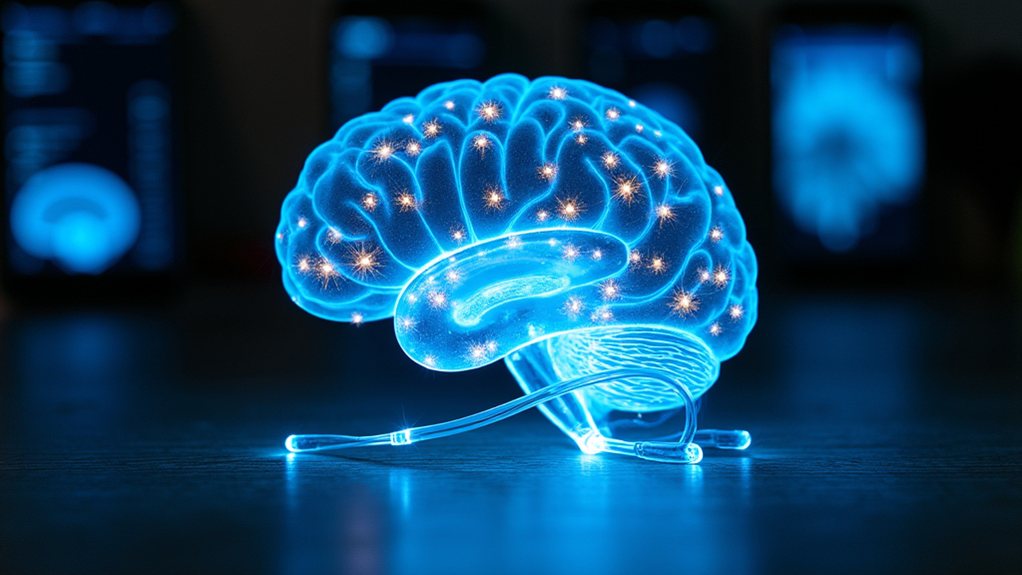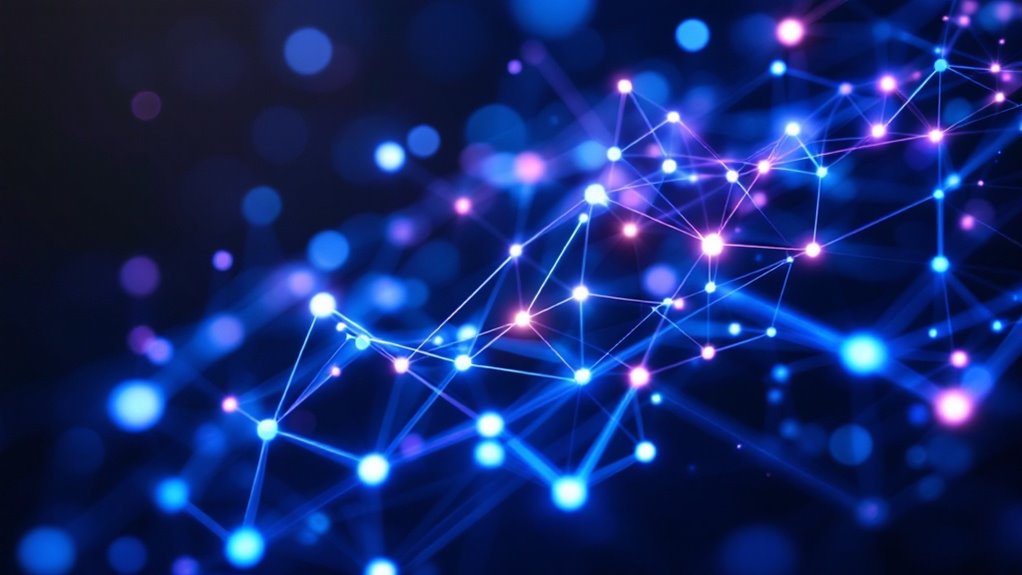

Neural networks mimic the human brain’s structure, processing data through interconnected layers of digital neurons. Information enters via input nodes, travels through hidden layers where calculations occur, and emerges as output. Each connection carries a weight that adjusts during training through backpropagation. The network learns by comparing its predictions to correct answers and tweaking those weights accordingly. Activation functions add the non-linear magic that helps these digital brains tackle everything from identifying cat photos to translating languages. Stick around to unravel the mathematical wizardry behind the AI revolution.
While most of us visualize a tangle of digital neurons when we hear “neural networks,” these computational powerhouses are actually remarkably organized systems. Inspired by the human brain, they’re structured in layers of nodes—think of them as digital neurons that pass signals to one another. And no, they’re not plotting world domination… *yet*.
These networks consist of three main components: an input layer (where data enters), hidden layers (where the magic happens), and an output layer (where answers emerge). Each node connects to others through weighted pathways that determine how much influence one node has over another—kind of like how some friends’ opinions matter more to you than others. At their core, neural networks represent deep learning techniques that operate as a specialized subset of broader machine learning methods.
Think of neural networks as your digital friend circle—with certain connections carrying more influence than others.
When data enters the network, it travels forward in what’s called a feedforward process. Each node performs a calculation, applying weights to incoming signals and determining whether to “fire” based on a threshold value. It’s fundamentally asking, “Is this input important enough for me to pass along?” If yes, it activates and sends its signal forward.
The real brilliance lies in how these networks learn. Through a process called backpropagation, the network compares its output to the correct answer and adjusts those connection weights accordingly. It’s like learning from your mistakes, but without the embarrassing memories. This training happens iteratively—thousands or millions of times—until the network becomes remarkably accurate. The network’s performance is evaluated using cost functions that measure the difference between predicted and actual outputs.
Neural networks apply various activation functions—sigmoid, ReLU, or tanh—to introduce non-linearity, allowing them to capture complex patterns in data. Without these functions, neural networks would just be glorified linear regression models (yawn).
The applications are everywhere: they’re analyzing your photos, translating your texts, and powering your voice assistants. They excel at image recognition, often surpassing human capabilities. Modern neural networks have evolved dramatically from the original Perceptron introduced in 1957, which was the first trainable neural network with a specified learning mechanism.