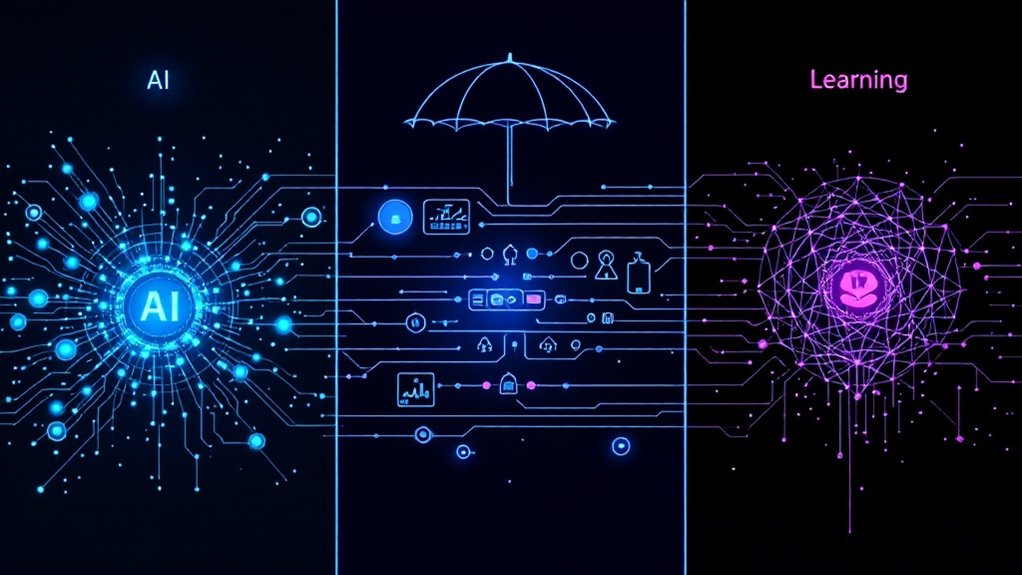

AI is the broad umbrella term covering all machine intelligence, while Machine Learning is its ambitious middle child that learns from data without explicit programming. Deep Learning, the precocious youngest sibling, takes this further by using neural networks inspired by the human brain. The key difference? ML needs humans to identify important features, while DL figures them out automatically—but demands massive datasets and computational power. Keep scrolling to unpack this tech family drama.
Confusion reigns supreme in the tech world when it comes to distinguishing between AI, machine learning, and deep learning. These terms get tossed around like confetti at a tech conference, often interchangeably—and incorrectly. Let’s set the record straight, shall we?
Artificial Intelligence encompasses the entire field of making machines “smart.” It’s the ambitious parent category that includes everything from your basic if-then decision trees to complex systems that power self-driving cars. Think of AI as the technological equivalent of an umbrella term—broad enough to cover both your grandmother’s chess-playing computer program and the algorithm deciding which TikTok videos will keep you scrolling until 3 AM.
Machine learning represents AI’s overachieving middle child. This subset focuses specifically on systems that improve through experience without explicit programming. ML algorithms—like decision trees and linear regression—can work with relatively modest datasets and moderate computational resources. Your spam filter? That’s machine learning doing its thing on your CPU, without requiring a small power plant to operate.
Deep learning, meanwhile, is the precocious youngest sibling that gets all the attention. This specialized branch of machine learning uses artificial neural networks inspired by the human brain. Deep learning excels particularly at finding complex patterns in unstructured data like images and speech recordings. It demands massive datasets and computational power (hello, expensive GPUs!), but it rewards this hunger with impressive capabilities in speech recognition, image processing, and other complex tasks. When your phone recognizes your face or Alexa understands your mumbled request, you’re witnessing deep learning in action. These applications often utilize natural language processing to interpret and respond to human commands in an intuitive way.
The key differences? Scale and independence. Machine learning requires humans to identify important features in data, while deep learning automates this process. ML works with thousands of data points; deep learning craves millions. Current statistics show that approximately 35% of businesses globally have implemented some form of AI technology in their operations, with many more exploring its potential.
And while machine learning plateaus in accuracy after a certain point, deep learning keeps improving with more data—if you’re willing to foot the electricity bill, that is.