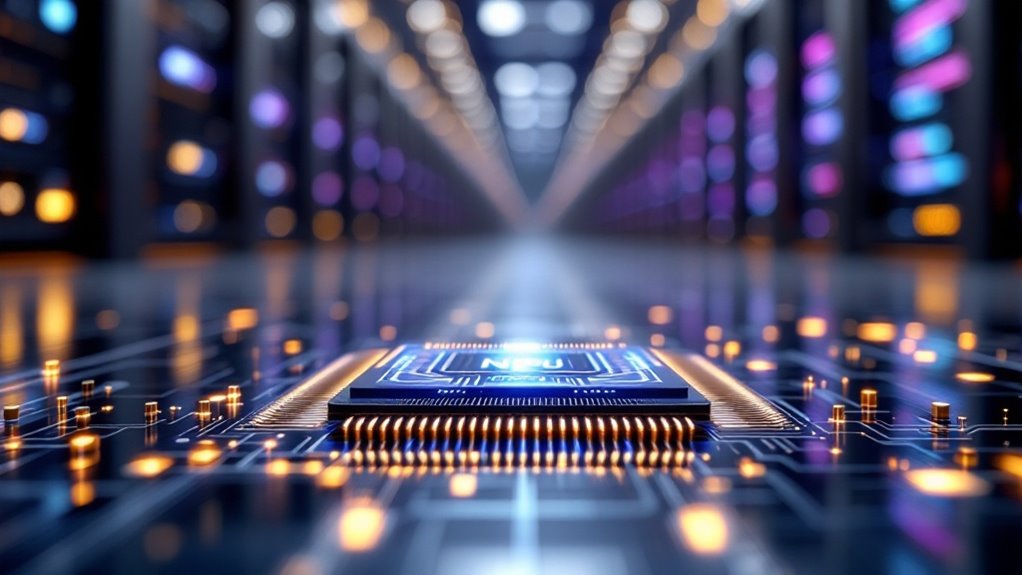

NPU chips are manufactured by tech giants like NVIDIA, AMD, and Intel, plus ambitious startups like SambaNova and Cerebras. Cloud companies AWS, Google, and Microsoft are also designing their own custom AI silicon. These “math wizards” excel at neural network operations, enabling everything from facial recognition to autonomous vehicles with their parallel processing superpowers. While regular CPUs struggle with AI workloads, NPUs deliver the speed and efficiency modern smart devices crave. The silicon aristocracy’s newest battleground awaits exploration.
Silicon powerhouses, quietly reshaping our digital landscape. Neural Processing Units (NPUs) are the unsung heroes behind your phone’s ability to recognize your face faster than your own mother sometimes can. The major players in this high-stakes chip game include the usual suspects: NVIDIA, AMD, and Intel – the aristocracy of silicon, if you will.
The silent revolution of silicon—NPUs identifying your face while your mother still squints at holiday photos.
But don’t sleep on the cloud giants. AWS, Google, and Microsoft aren’t just hosting your forgotten photo albums; they’re designing their own AI chips to power the massive data centers that keep our digital lives humming along. Microsoft has recently developed Azure Maia 100 chips specifically designed for custom AI models, offering versatile solutions for businesses.
Then there’s the plucky startups – SambaNova, Groq, Cerebras – the Silicon Valley equivalent of indie bands, hoping their specialized AI accelerators will be tomorrow’s platinum hits. NVIDIA’s DGX Spark desktop supercomputer brings supercomputing power into a compact form factor for AI engineers and data scientists. These chips excel at powering the computer vision systems that allow autonomous vehicles to detect and respond to their surroundings. Behind them all stand the manufacturing titans TSMC and Samsung, turning digital dreams into physical reality, one wafer at a time.
What makes these chips special? They’re basically math wizards on steroids. While your regular CPU is a decent all-around student, NPUs are those annoying savants who can multiply massive matrices in their sleep. They process parallel data streams with an efficiency that makes traditional chips look like they’re solving equations with an abacus.
NPUs differ from their cousins in the chip family. GPUs might throw the better parties with their broad parallelism, but NPUs show up with laser focus on neural network operations. They’re the specialists you want when milliseconds matter.
Why should you care? Because without these chips, your smart speaker would be dumb as rocks, your autonomous vehicle would have the directional sense of a toddler, and generating that AI art of “cats playing poker in space” would take weeks instead of seconds.
The market’s heating up faster than a laptop running Crysis. With competition fierce between East and West, these tiny silicon squares have become geopolitical chess pieces in a global technology race.
And just like that smartphone in your pocket – they’re not going anywhere.