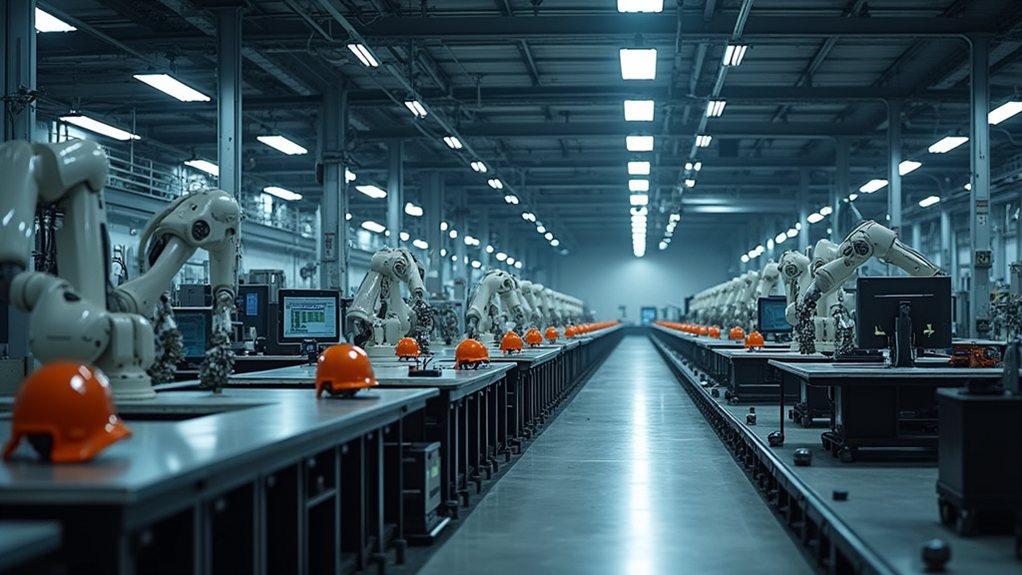

Microsoft’s $80 billion AI investment is definitely shaking up tech careers. Traditional coding and IT support roles face automation risks, while AI trainers and prompt engineers become hot commodities. The game’s changing fast—yesterday’s must-have skills might be tomorrow’s relics. Tech professionals need to pivot quickly, embracing continuous learning as their new BFF. Think of it as career Darwinism: adapt to working alongside AI, or risk digital extinction. The coming shift makes cloud computing look like a minor software update.
As Microsoft prepares to funnel a staggering $80 billion into AI infrastructure in 2025, the tech giant is reshaping not just its own future but potentially your career trajectory too. The company’s colossal investment signals a fundamental shift in how tech work happens—and who (or what) will be doing it in the coming years.
Microsoft’s recent revelation of “multi-AI” Copilot in GitHub tells us everything we need to know about where things are headed. By integrating Anthropic Claude, OpenAI Codex, and other AI models, they’re fundamentally creating a programming polyglot that makes your average coder look like someone still using BASIC on a Commodore 64.
These AI agents aren’t just assisting with code—they’re taking over entire segments of the development lifecycle.
The writing’s on the wall for certain tech roles. Repetitive coding tasks? Consider them automated. Basic IT support? The bots are coming.
But before you throw your mechanical keyboard out the window, there’s a plot twist: new roles are emerging just as quickly.
Companies are now hunting for AI model trainers, prompt engineers, and specialists who can orchestrate these digital workers. “Fusion teams” combining tech expertise with domain knowledge are becoming the new organizational structure, replacing traditional siloed departments.
It’s less “your job is gone” and more “your job is evolving at warp speed.”
Microsoft’s strategic diversification—embracing models from Anthropic, OpenAI, and xAI—isn’t just about hedging bets. It’s creating an ecosystem where adaptability reigns supreme. The exponential growth of AI capabilities doubling four times faster than historical technological progress means professionals must accelerate their learning curve accordingly.
For tech professionals, this means continuous learning isn’t optional anymore; it’s as crucial as your morning coffee.
The skills landscape is shifting beneath our feet. Those who can direct AI tools, curate domain-specific data, and oversee autonomous processes will thrive. The demand for Machine Learning Engineers is projected to grow by over 20% through 2033, highlighting the industry’s shift toward AI implementation. Microsoft’s partnerships with community colleges demonstrate a commitment to making AI education accessible to Americans from all backgrounds.
Everyone else might find themselves competing with increasingly capable digital colleagues.
Your future in tech depends less on what you know today and more on how quickly you can adapt to tomorrow’s AI-augmented reality.