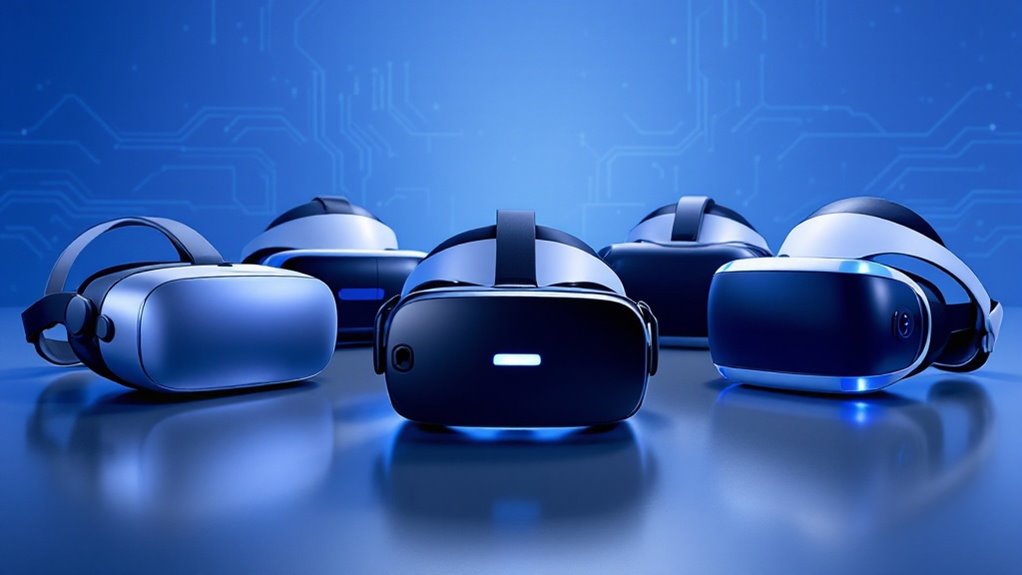

The VR headset market features several major players battling for your virtual attention. Meta dominates with its Quest lineup, while Apple recently jumped in with the pricey Vision Pro. Don’t forget Sony’s PlayStation VR2 for console gamers, HTC’s Vive for enterprise solutions, and Valve’s Index—the gold standard for PC gaming snobs. Behind the scenes, companies like Qualcomm and Goertek provide the tech that makes head-mounted escapism possible. Stick around to see which company might win the virtual reality race.
The battle for your face-based computing attention is heating up. What once seemed like a sci-fi pipe dream has transformed into a multi-billion dollar industry, with tech giants and specialized manufacturers all vying to strap their particular flavor of digital reality to your noggin.
Meta continues to dominate the VR landscape with its Quest lineup, offering both consumer-friendly Quest 3 and the business-focused Quest Pro. The company formerly known as Facebook clearly wants to own your eyeballs before anyone else does—and they’re doing a pretty good job of it in North America and Western Europe.
Meta’s Quest lineup reflects a simple strategy: control the future of computing by claiming your face first.
Not to be outdone, Apple finally jumped into the mixed reality pool in 2024 with the Vision Pro. It’s exactly what you’d expect from Apple: gorgeous, powerful, and priced like it’s made of unobtainium. The headset features Apple’s innovative visionOS operating system, combining virtual reality, augmented reality, and mixed reality technologies.
For the PC gaming crowd, Valve’s Index remains the gold standard, while HTC’s Vive continues to serve both consumer and enterprise markets with reliable, if somewhat unsexy, hardware. Sony keeps console gamers happy with PlayStation VR2, though they’re basically playing in their own walled garden. Many headsets feature either 3DoF or 6DoF tracking capabilities, with the latter offering a more immersive experience by tracking both position and rotation.
Behind the scenes, companies like Goertek manufacture components for these headsets, while Qualcomm’s Snapdragon XR chips power many standalone devices. NVIDIA contributes with its CloudXR streaming tech, fundamentally turning your headset into a portal to more powerful processing elsewhere.
The enterprise market tells a different story. Varjo and Vrgineers create ultra-high-end headsets for simulation and training, with price tags that make even Apple blush. HP’s Reverb G2 quietly serves business users who need Windows integration.
Looking eastward, Pico has cornered significant market share in Asia, while Lenovo offers educational solutions globally.
Industry projections suggest standalone headsets will dominate 60% of the market by 2025, with global shipments having surpassed 8 million units in 2023. As mobile chipsets advance and cloud streaming improves, your next VR headset might actually be affordable—and might not give you neck pain after 20 minutes.